

I don’t know about you, but I’m looking forward to Christmas and New Year as an opportunity to recharge and reset. If like me and today’s guest blogger, you are feeling a little burnt out and overwhelmed by everything the year has thrown at you, this is your blog.
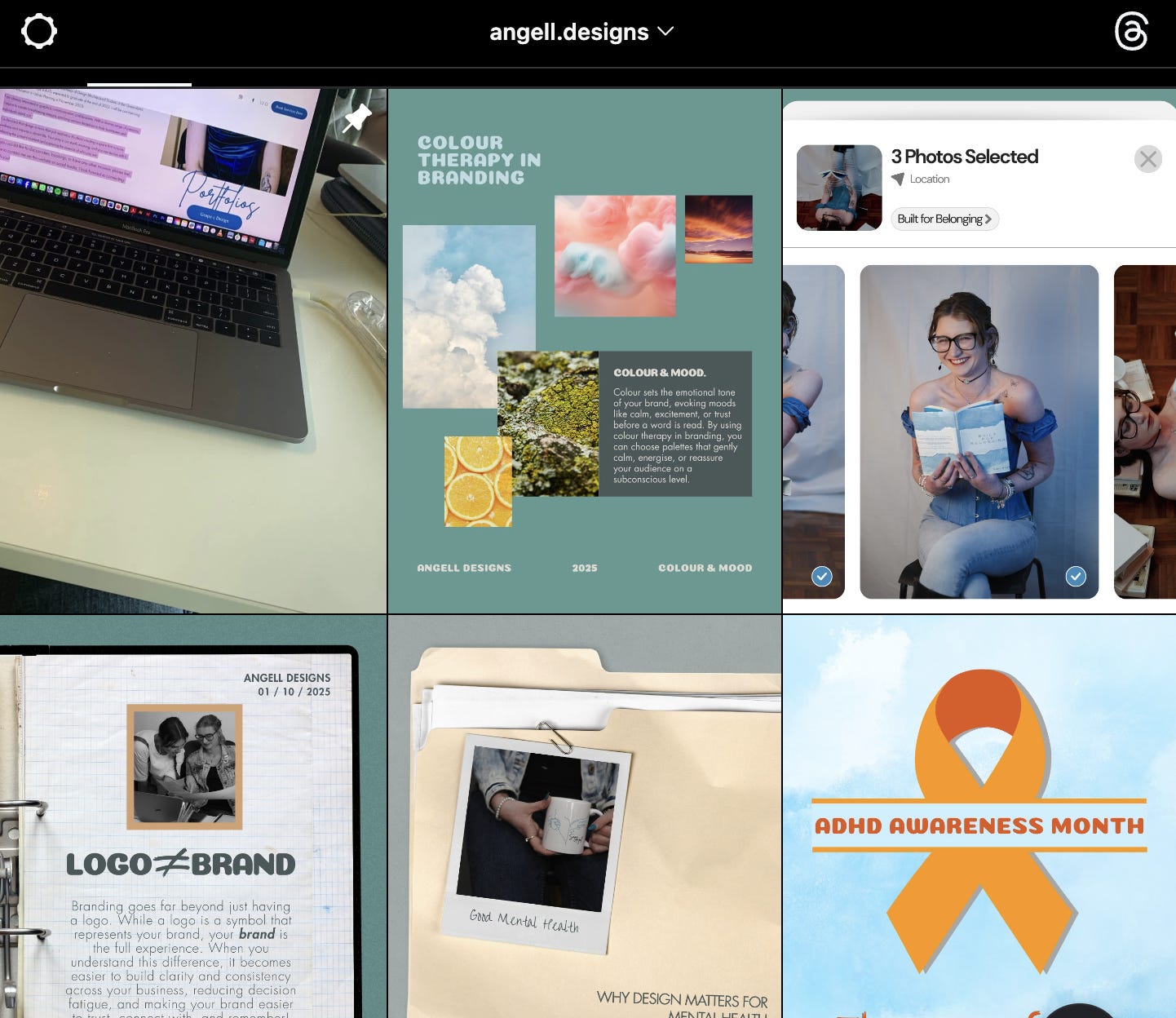
Sam Angell is an ambidextrous Brisbane-based branding specialist, author, and small business owner. When they aren’t running their design business, you’ll usually find them with Ivy their cat, crafting a sewing project, or deep diving into music (often Taylor Swift or Bright Eyes).
Over to Sam…
Open your phone right now and you’ll feel it. The flood of notifications, the endless scroll, the sense that you can’t keep up. That jittery feeling? That’s digital burnout.
We often frame burnout as if it’s a personal failing: I just need better boundaries, I should delete Instagram, I should just focus. The reality is far more systemic. Burnout is built into the very way brands communicate online. Burnout is being caused by the way brands communicate online. The pressure to always be present creates too much noise. Too many touchpoints. Too little care for the human being on the other side of the screen.
It’s affecting us marketers too. As a branding specialist and designer who also manages their own disabilities, I can’t afford to pretend I can run on a never ending treadmill of content. My body and mind simply won’t let me. And as much as I resisted those limits at first, they’ve become the lens that reshaped how I see branding. Branding is not a sprint for attention, but is a practice of care, clarity, and sustainability.
Which leads me to argue that brands should put well-being first in 2026.
Well-being Should Always Be Considered in Every Design
Burnout has never been abstract for me. It has lived in my body. I’ve had weeks where a lupus flare-up left me unable to lift my arms, yet my inbox still demanded replies. I’ve had days where ADHD scattered my focus across too many tabs and to-do lists that I ended up paralysed, staring at a blinking cursor. Bipolar disorder has pulled me between sleepless manic nights of over-promising and the inevitable crash into depression, where even answering a simple email felt impossible. The pings. The constant shifting demands. The visual clutter of poorly designed platforms… It doesn’t just annoy me. It overwhelms me to the point of shutdown.
For a long time, I thought these realities made me a less capable designer as I was always falling behind the pace of “normal” business owners. What I’ve come to realise is that these very limits have reshaped how I approach branding. They’ve taught me to value clarity over chaos. Intention over noise. breathing room over constant output. Health-first design didn’t come to me as a strategy. It came as survival.
Now, it’s become the foundation of my work. The brands I build don’t just look good, they feel good. They give people a sense of calm, of ease of being seen rather than feeling overwhelmed. What once felt like my weakness is now a new perspective; my proof that design isn’t just about the aesthetics. It can’t be only aesthetics. Design needs to be about creating systems that care for the human beings on both sides of the screen.
When I strip back clutter in my work, my clients breathe easier.
When I design branding systems with flexibility, small business owners stop panicking about keeping up.
When I build in accessibility from the start, people feel seen and valued rather than feeling excluded.
For years, I believed slowing down meant I wasn’t cut out for business, that pausing a project for rest or pushing back on a deadline was proof I wasn’t “serious” enough to compete. Over time, I learnt that those so-called weaknesses were actually teaching me how to build brands differently. Slowing down allowed me to notice what really mattered instead of burning out by chasing every new trend. Simplifying revealed a form of clarity within my branding projects. Honouring my needs gave me the resilience to keep showing up. Not in frantic bursts that left me depleted but in sustainable rhythms that supported both me and my clients.
How brands create burnout
Some of the ways brands can create burnout are:
Overly complicated visuals
Visual complexity has measurable negative effects on how people respond to your site or brand. In one study on websites’ visual complexity, too many visual elements, images, colour, and clutter lowered user satisfaction. Another related study observed an inverse relationship between design complexity and purchase intention. The studies indicated that as perceived complexity increases, people were less likely to stay on the site or make a purchase. First impressions are formed rapidly, often in milliseconds, and visual clutter undermines trust and professional perception.
There are too many channels
It’s not just you feeling stretched thin by trying to maintain a presence on every new social platform, email list, messenger app, or channel. A study in 2025 found that 94% of marketers use social media as part of their core strategy. Many are juggling post schedules across multiple platforms including Instagram, TikTok, LinkedIn, and Facebook. Although digital ad spend continues to climb into the hundreds of billions, spreading this too thin comes at a cost. Audiences tend to only meaningfully engage with the channels they trust, remember, or habitually visit. Being everywhere often means being nowhere deeply.
Putting well-being First in 2026
Audiences are tired, overstimulated, and craving clarity so I believe that in 2026, brands that prioritise health and well-being in their design will be the ones that lead the way.
So, what does putting well-being first look like?
Accessibility is standard
One way to consider your audience’s well-being is by incorporating accessibility into your assets. As well as showing that your brand values everyone, what makes something better for people with a disability makes it better for everyone, and some of the stresses are removed.
That might look like:
Writing clear, easy-to-understand text (no unnecessary jargon or tiny grey fonts)
Using strong colour contrast so text is easy to read
Adding short image descriptions (called alt text) so people using screen readers can understand what’s on the page
Making sure sites are easy to navigate on both mobile and desktop devices
Posting less
You don’t need to post every single day to be successful. Instead of chasing every new trend, why not create consistent, meaningful content that feels good to make and easy to digest.
That could look like:
Choosing one or two key platforms and showing up there with purpose
Planning a realistic posting schedule that fits your energy levels and capacity
Sharing content that adds value to audiences
When you create from rest, your content lasts longer and connects deeper with your audience.
Values-led storytelling
Share stories that reflect who you are (your purpose, your beliefs, your care for your community) instead of using fear or pressure to convince people to buy.
Think about the difference between:
“Don’t miss out – Only 3 left!” versus “We value slow, considered choices. Take your time to see if this is right for you.”
“Perfect your morning routine!” versus “Find what works for your body and your pace.”
When your marketing aligns with your values, people feel that integrity. They trust you because you meant what you said.
The brand that whispers clearly will always be heard
Clarity cuts through chaos in a way volume could never. When every brand is shouting for attention, the one that speaks with calm confidence and genuine values stands out as a relief. People are tired of being yelled at by algorithms. They’re craving honesty, consistency, and care. By 2026, audiences won’t reward loud behaviour anymore. They’ll reward brands for being kind and communicating with intention. Health-first branding isn’t charity. It’s a strategy. Because when you respect human limits, you build loyalty that lasts longer than any algorithm.
Thank you Sam! If you would also like to be featured on the All About Digital Marketing blog, read my collaborations blog and get in touch at contactme@louisaguiseauthor.com. Please note that blog activity might be quieter over Christmas and into January.
What we haven’t had yet on the All About Digital Marketing blog
Holiday-specific content - how do you prepare for and run a Christmas/Hanukkah/Diwali/Ramadan/Valentines/Halloween etc. promotion?
Design and asset tips - we’ve had a few, but I’d love content creators, programmers and artists to share practical tips that marketers and small businesses can use in their work.
Author content - I’ve featured a few authors, and as an author myself, I’d love to help other authors learn how to market their books. If you are an author, and you have some brilliant marketing tips, get in touch.